
ADU Task Force Recommendations
The recommendations of the mayor's ADU Task Force which has been meeting over the past year are here!
|
|
- Full presentation (PDF)
- Meeting Stream (Youtube) - presentation begins ~02:38:00
The City's full zoning re-write resulting from the 2024 Master Plan is expected, at least in draft form, by Summer of 2027. The City Commission would then consider adoption. Updates related to the recommendations of the ADU Task force would likely be considered in the fall of this year (2026).
The Recommendations
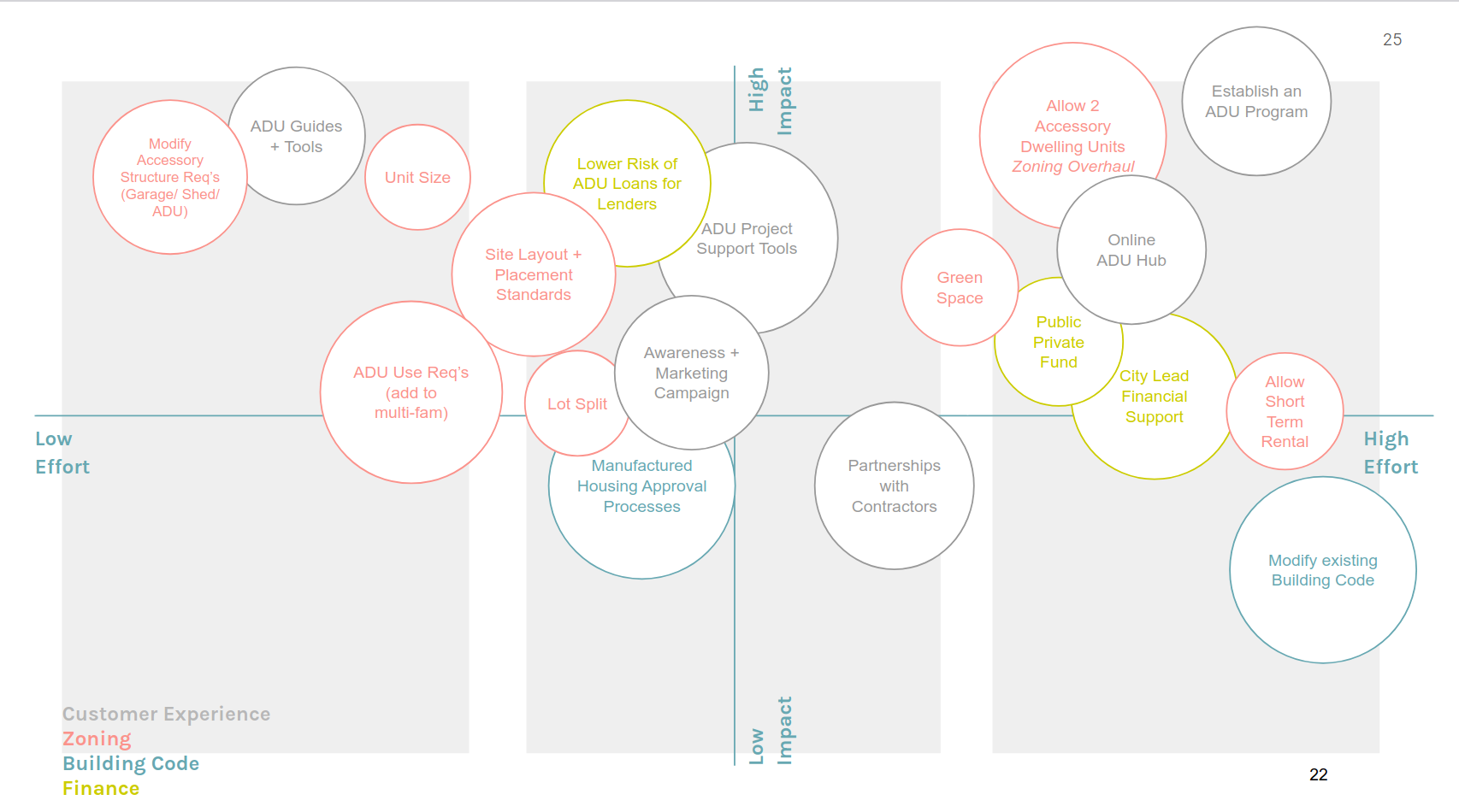
Classification: 🏫 : Educational, 💰 : Financial, 🚨 : Regulatory, 🦮 : Assistance. These are my classifications; numerous of these recommendations I have classified as Assistance (🦮) as they are, in practice, the same recommendation but with varying levels of effort and resources invested.
Feasibility / Difficulty: 1️⃣ (easy) 2️⃣ (medium) 3️⃣ (hard), this is the city's estimate of difficulty.
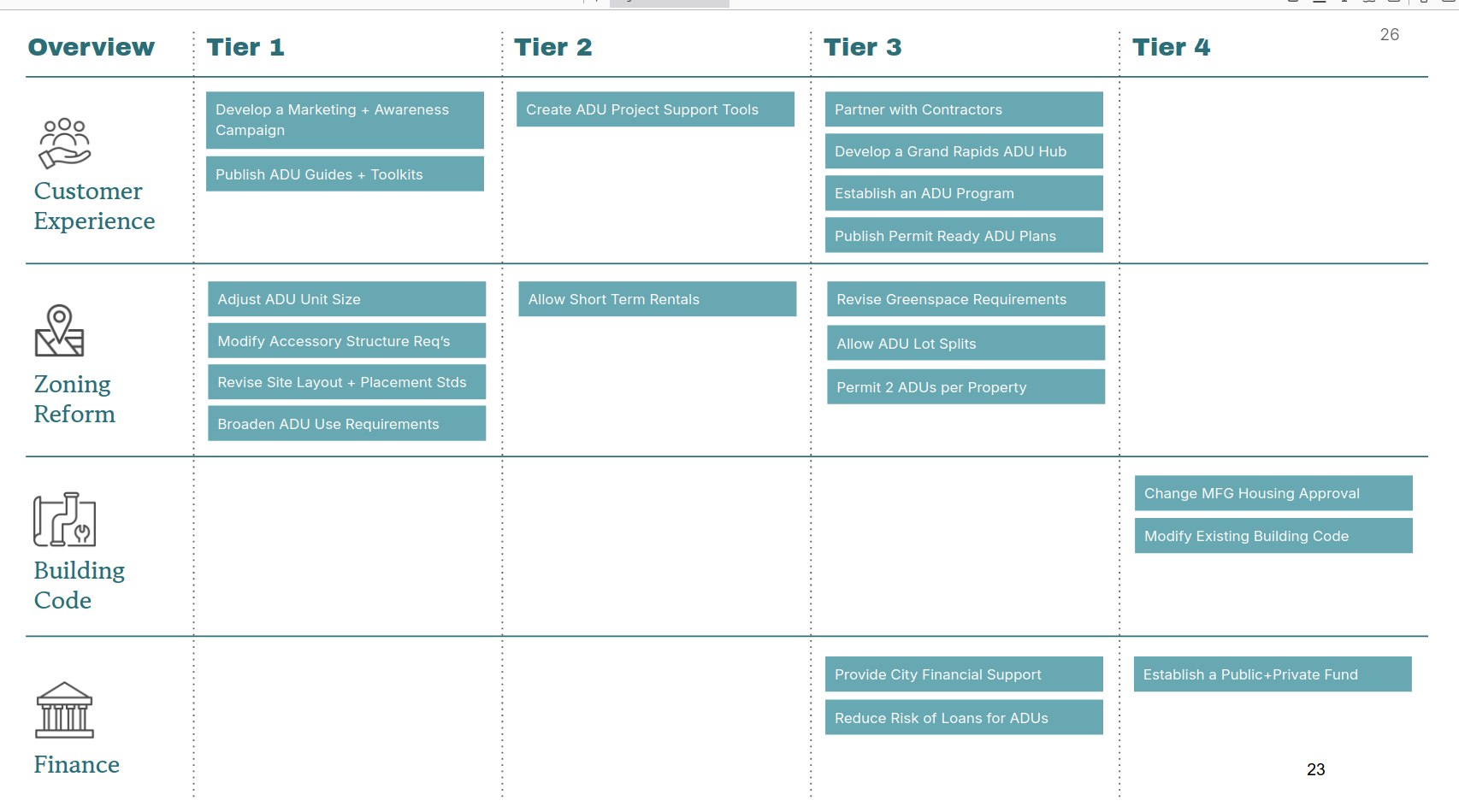
- 1️⃣🚨 Adjust ADU Unit Size : Modify the current arbitrary limitations imposed by the zoning ordinance to be more generous. Currently ADUs are limited to 40% of the size of the primary structure, with a maximum of 850sq/ft. Also, potentially, exclude non-living spaces from the calculation as, due to their small size, features like a staircase are a significant portion of the floor area. This could go as far as to simply eliminate the arbitrary limitation and rely on the other constraints of the zoning ordinance (green space, set backs, etc...) and building codes (set backs, fire rating, etc...) to constrain design by less arbitrary factors.
- 3️⃣🚨 Allow ADU Lot Splits : ADUs are traditionally rental units attached to the ownership of the primary structure. Accommodations could be made for ADUs to be condo-ized. This would facilitate financing and creation ownership opportunities.
- 2️⃣🚨 Allow Short Term Rentals : One of the arbitrary constraints applied to ADUs by the current zoning ordinance is forbidding use as a short-term rental (STR). This discourages the creation of ADUs by denying a [potentially] financially advantageous use. An ADU constructed for aging in place or multi-generational living may have a period of time before that use is necessary, but the unknown duration of that period makes a traditional lease agreement problematic. Even an ADU constructed initially with the intent to be an STR is the creation of a residential unit which can subsequently transition to a tradition lease or potentially be condo-ized (creating ownership opportunity).
- 1️⃣🚨 Broaden ADU Use Regulations : The zoning ordinance applies a litany of arbitrary constraints to how ADUs ... and, yeah, pretty much anything ... can be used. Can an ADU be used as a home office? No, and technically neither can the primary structure. Is this in any way enforced by the city? Of course not! Because even the most devote of city staff know that attempting to enforce such a rule would result in unemployment. For ADUs this also includes a limitation to two bedrooms; which raises the question of why the city discourages families?
- 3️⃣🚨 Change Manufacturer Housing Approval : Use of manufactured housing is regulated by Michigan Public Act 2320, placing this in the hands of the state legislature, the City Commission cannot do this.
- 2️⃣🦮 Create ADU Project Support Tools : this option rolls a collection of options into a collection of tools, but less than options like "Publish Permit Ready ADU Plans" (rather a template). This recommendation seems particularly nebulous.
- 3️⃣🦮 Develop a Grand Rapids ADU Hub : ... I have no idea what this means. It appears to be a step up in effort from "Publish ADU Guides & Toolkits" and "Create ADU Project Support Tools", but less than "Provide city financial support". This category of recommendations is really a single recommendation on a slide scale of effort and resources.
- 1️⃣🏫 Develop a Marketing & Awareness Campaign : Promote awareness of the ADU housing type, promote as an opportunity.
- 3️⃣🦮 Establish an ADU Program : There are currently no city staff designated to specifically deal with ADUs. This means responsiveness and the level of assistance varies depending on other demands. The city could choose to dedicate staff hours and related resources to ADU support and approval.
- 3️⃣💰 Explore Innovative Financing Models : Financing of housing types which the Urban Planners made illegal in the mid-20th century is challenging as the financial instutions are not longer adapted to support them. The city could cultivate relations with lenders, establish public/private partnerships, or even have the GR Land Bank backstop a loan program; all in order to accelerate the availability of financing options.
- 1️⃣🚨 Modify Accessory Structure Requirements : The zoning ordinance applies a litany of arbitrary constraints related to accessory structures; these are any and all structures on a property other than the primary structure. This could also simply exclude ADUs - as they are residential in use - from the accessory structure classification; otherwise, aren't we telling someone that their home is "accessory"?
- 3️⃣ 🚨 Modify Existing Building Codes : Building codes in Michigan can only be changed at the state level, the City Commission cannot do this.
- 2️⃣🦮 Partner With Contractors : The city could cultivate a list of contractors with ADU experience and potentially develop and ADU certification program. This is potentially also a means by which the city could create opportunities for local and MLBE contractors.
- 1️⃣🚨 Permit Two (2) ADUs Per Property : Allowing for the construction of two (2) ADUs on a property rather than one (1) would not only create additional housing, it provides the greatest cost discount of any option proposed. The cost of site preparation, grading, utilities - especially water and sewer - could be divided by two. If properly drafted this option, along with other edits to the arbitrary zoning ordinance, this would create the option of JADUs (Junior ADUs), which are micro-apartments which are part of a larger ADU structure, but sharing the same utilities [cost]; the most affordable construction of new housing possible.
- 2️⃣💰 Provide City Financial Support : The city could step into financing in a direct way, including PILOT, TIF, grants, and assessment tools. How could these bureaucratic and paper-work heavy tools be effectively used for small projects constructed independently? My skepticism abounds.
- 1️⃣🦮 Publish ADU Guides & Toolkits : Create visual guides and toolkits to assist those interest in ADUs with the decision process.
- 1️⃣🦮 Publish Permit Ready ADU Plans : This is what is says, and the city has already published pre-approved plans one, two, and four unit structures. How well this would work for ADUs is the question; ADUs are being sited on already developed parcels, meaning there are many geometric constraints and other contextual issues. The city lists this option as "easy", yet it took them over a year to select and publish the already available permit-ready places - which are the plans from a Michigan Municipal League publication.
- 3️⃣💰 Reduce Risk of Loans for ADUs : Provide a special assessment which will allow lower-income but long-time residents access the accumulated equity in their property for ADU construction. The availability of HELOC (Home Equity Line Of Credit) loans is often constrained by household income even when the equity exists.
- 1️⃣🚨 Revise Greenspace Requirements : The zoning ordinance contains arbitrary greenspace requirements of 20% - 60%, with most of the city requiring more than 40% of a lot be undeveloped. This is true even in neighborhoods where one can see high-rise buildings from the sidewalk. Accessory structures count against a properties greenspace requirements. The city could reduce or elimiante greenspace requirements, or not include an structure which is an ADU [and someone's home!] in the calculation. The city could also draft new, albeit just as arbitrary, ways to count greenspace such as including green walls [which I am certain will be as effectively enforced as other landscape requirements...]
- 1️⃣🚨 Revise Site Layout & Placement Standards : The zoning ordinance applies a litany of arbitrary constraints to where accessory structures can be located on a lot. This is especially true for corner lots. For example, an ADU must be setback from the alley, at the rear of the property? In most alleys in traditional neighborhoods the rear structures [mostly garages] sit at or very near the alley right-of-way. Permitting an ADU to be set against the alley potentially preserves back yard greenspace.
Related
Beware when doing research on the Internet. There are numerous site now providing out-of-date or inaccurate information about ADUs related to Michigan; much of this content is likely to be AI slop.
- Selling Guide Announcement (SEL-2025-10), (PDF) Fannie Mae 2025-12-10
- Fannie Mae financial eligibility has been expanded significantly, including for multiple ADUs on a single properties (pg 3)
- ADU 535 Shirley St (Fiscal), UrbanGR 2026-08-28
- ADU 535 Shirley St, UrbanGR 2020-01-31
- Shelterforce ADU Series, UrbanGR 2022-05-10
- ADU Convening, UrbanGR 2020-11-04
- Zoning: Accessory Dwelling Units, UrbanGR
- GR Zoning Rules for ADUs, MIBackyardBuild 2025-04-08